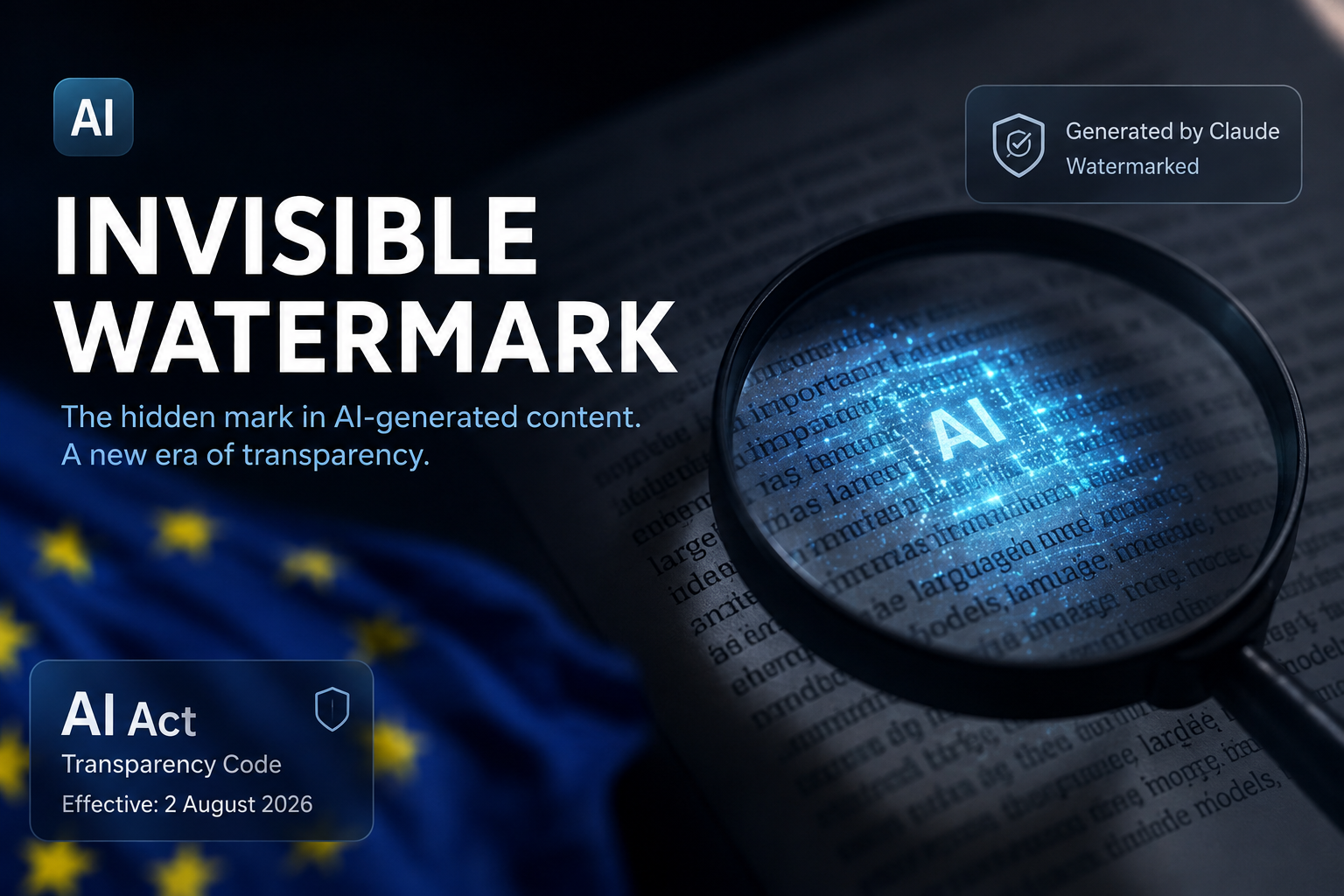
A mark you cannot see, built into the words themselves
Anthropic confirmed in mid August that Claude now embeds an invisible watermark into the text it generates, across the Claude platform, the API, Claude Code, Claude Cowork and Claude Tag. Any model released after 2 August 2026 carries the feature automatically, with support for older models being extended over time.
The mechanism is what makes this different to older AI detection attempts. The watermark is not a metadata tag bolted onto a file, which vanishes the moment someone copies the text into a new document. Anthropic's own description is direct: "Because the watermark is part of the text, it will travel with the text when it's copied and pasted elsewhere, and may persist through some editing." For files rather than raw text, Anthropic is using C2PA, an open industry standard already used for labelling AI generated images and video.
Why now, specifically
This is not Anthropic acting purely out of goodwill. The EU's AI Act Transparency Code took effect on 2 August 2026, and it requires AI companies to mark AI generated or AI edited content in ways that can actually be detected. Anthropic's watermark rollout lines up with that date precisely.
That timing matters for how you should read this. It is not a voluntary trust building exercise Anthropic dreamed up independently, it is a company positioning itself ahead of a regulatory requirement that is about to apply well beyond the EU's own borders, the same way privacy rules like GDPR ended up shaping how companies operate globally, not just in Europe.
The honest limitation nobody has fully answered yet
Here is the part worth sitting with rather than skimming past. Anthropic has not clearly specified how much editing it takes before the watermark breaks. Reporters covering the rollout asked directly and did not get a precise answer.
That is a real gap, not a minor technical footnote. A watermark that survives light copy pasting but disappears after a few sentences of human rewriting is a very different tool to one that survives serious editing. Until that threshold is public and testable, treat "watermarked" as a signal with a known blind spot, not a guarantee.
What this actually solves, and what it does not
To be fair to the idea, invisible watermarking solves a real problem. As AI generated text becomes harder to distinguish from human writing by eye, the "AI slop" problem, low effort, mass produced content flooding search results, comment sections and marketplaces, gets harder to police without some kind of built in signal. A watermark that survives copy paste is a genuine technical improvement over nothing.
What it does not solve is intent. A watermark tells you content came from Claude. It does not tell you whether that content is accurate, whether it was fact checked, or whether a human reviewed it before it went out under a business's name. Businesses have sometimes treated "AI generated" and "unreliable" as the same problem. They are not. A watermark addresses only the first question.
What this means for any business using Claude to write
Assume detectability is coming for all AI text, not just Claude's. Anthropic moving first under EU pressure signals where every major AI provider is heading. If your business publishes AI assisted content, marketing copy, reports, customer communications, plan for a future where "was this AI generated" has a technical answer, not just a policy one.
This is not a reason to stop using AI for drafting. It is a reason to be honest about what AI touched and what a human reviewed. Businesses that already disclose AI assistance where it matters have nothing to adjust here. Businesses relying on nobody being able to tell the difference just lost some of that cover.
Watch how this affects platforms you publish on, not just Claude itself. If search engines, social platforms or marketplaces start reading these watermarks to flag or deprioritise AI content, that is a downstream effect worth tracking well before it becomes a ranking problem for your business.
The honest read
A watermark that travels with copied text is a genuine technical step forward, and the EU regulation behind it is going to reshape how every AI provider handles this, not just Anthropic. The open question, how much editing actually removes it, is the one worth watching closely before treating this as a settled, reliable system rather than a first version of one.
Sources
TECHMOOSE AI
Ready to put AI to work in your business?
TechMoose AI builds voice agents and chatbots that answer calls, take bookings and handle support, live in minutes, not months.
Try TechMoose AI