The headline number, and the one hiding just beneath it
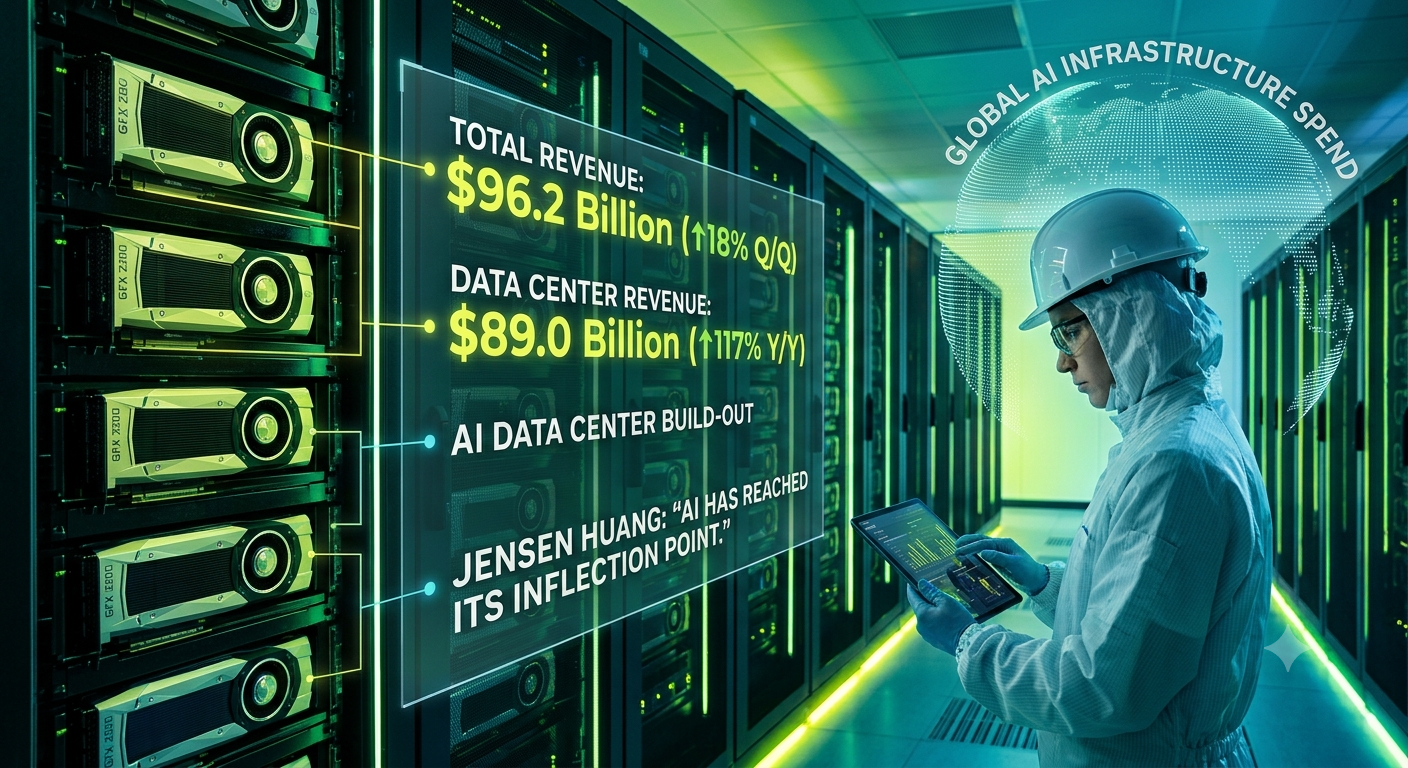
On 26 August, Nvidia reported second quarter fiscal 2027 results, total revenue of $96.2 billion, up 18 per cent from the previous quarter and 106 per cent from the same quarter a year earlier. That is not incremental growth, revenue has effectively doubled in twelve months.
The number underneath it explains where that growth is actually coming from. Data centre revenue reached $89.0 billion, up 18 per cent quarter on quarter and 117 per cent year on year, meaning data centres now make up roughly 93 per cent of Nvidia's entire business. Edge computing, by contrast, brought in $7.2 billion, up a comparatively modest 27 per cent year on year. Nvidia's growth story right now is, almost entirely, the AI data centre build out.
The line Jensen Huang chose to lead with
CEO Jensen Huang's own comment on the results is worth reading closely rather than skimming past as a routine investor soundbite, "AI has reached its inflection point. It's doing useful work. Its tokens are productive and profitable. Now, compute is revenue."
That is a genuinely different claim to the one the AI industry has been making for the past two years. The earlier argument was that AI compute was an investment, spend now, capability and returns follow later. Huang's framing here is that the return is already showing up, directly, in the revenue line, not as a promise about the future. Whether that claim holds up under scrutiny is a fair question, but it is a meaningfully different position than "trust us, this will pay off eventually."
The profitability numbers back up the scale, not just the growth story
Nvidia's GAAP gross margin sat at 75.0 per cent, an extraordinarily high margin for a hardware business at this revenue scale, and net income reached $59.7 billion for the quarter alone. Diluted earnings per share came in at $2.46 on a GAAP basis. This is not a company burning cash to chase growth, it is converting AI infrastructure demand into profit at a rate few hardware companies in history have managed.
Nvidia also returned $26.0 billion to shareholders in the quarter through buybacks and dividends, with $99.0 billion still authorised for future returns, and confirmed its next dividend of $0.25 per share, payable 1 October 2026.
The forward guidance is where the real signal is
Results are backward looking by definition, guidance is where a company tells you what it actually expects next, and Nvidia's is not modest. The company projected third quarter fiscal 2027 revenue of $108.0 billion, plus or minus 2 per cent, with gross margin expected to hold around 74.0 per cent. That guidance implies continued double digit sequential growth on top of an already record breaking quarter, not a plateau.
For a business this size to guide toward further meaningful growth rather than stabilisation is the detail analysts and competitors alike will be watching most closely. It suggests Nvidia itself does not see AI infrastructure demand slowing in the near term, a genuinely relevant data point for any business trying to judge whether current AI adoption and investment levels are near a peak or still climbing.
Why this matters even if you never buy a GPU
It would be easy to file this under "chip company posts good earnings" and move on, but the underlying signal reaches well past Nvidia's own balance sheet.
Nvidia's data centre revenue is effectively a real time gauge of how much the entire industry is spending to build AI infrastructure. When that number grows 117 per cent year on year, it reflects Amazon, Microsoft, Google, Meta and a long list of other companies collectively spending at a rate that shows no sign of easing, spending that ultimately underpins every AI product and service built on top of that infrastructure, including the tools your own business may already rely on.
Extraordinary margins at this scale suggest AI infrastructure demand is currently outrunning supply, not the reverse. A 75 per cent gross margin on $96 billion in quarterly revenue is not the profile of a market where buyers hold the pricing power. That has practical implications for cost, wait times and hardware access for any business further down the AI supply chain.
Guidance pointing to further growth is a genuine signal worth weighing against any "AI bubble" narrative you encounter. It does not settle the debate on its own, no single company's guidance does, but a company sitting at the centre of AI infrastructure spending choosing to guide upward rather than caution the market is a data point worth more than a single opinion piece either way.
The honest read
These are genuinely exceptional numbers, not incrementally good ones, and Huang's own framing, compute now generating revenue rather than simply promising future returns, is a meaningful shift in how the industry's central player is describing its own business. The healthy scepticism worth holding onto is that guidance is a forecast, not a guarantee, and a single company's results, however large, are one data point in a much bigger story about whether AI infrastructure spending is being matched by genuine, durable demand.
Sources
TECHMOOSE AI
Ready to put AI to work in your business?
TechMoose AI builds voice agents and chatbots that answer calls, take bookings and handle support, live in minutes, not months.
Try TechMoose AI