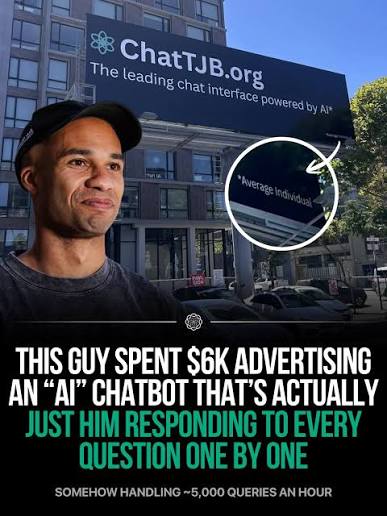
The billboard that started it
On 27 July, artist and former Google employee Tucker Bryant launched a website called ChatTJB, styled to look almost identical to ChatGPT's interface, and backed it with a real $6,000 billboard in San Francisco, half hidden behind trees. The catch was sitting in plain sight the whole time, in a disclaimer on the site itself, ChatTJB stood for "artisanal intelligence, handcrafted by a single human being," not artificial intelligence. Bryant answered every message personally.
At first, that was a manageable joke, 50 to 100 questions a day, easily handled by one person with a laptop. Then a video about the project went viral on Instagram, and traffic spiked to roughly 5,000 requests an hour. Bryant did not hire anyone or plug in a real AI model to cope with the load. He just kept typing.
What people actually asked "the AI"
The requests ranged from completely ordinary to properly bizarre. Recipes. Relationship advice. Hand drawn images, made by an actual human hand, on demand, at internet scale. Some users tried to troll the bot the way people troll real chatbots, which Bryant found fitting, pointing out that "ChatTJB is in some ways a troll itself."
The funniest part of the whole story is not the volume, it is what happened once people worked out there was a real person on the other end. Rather than feeling tricked, plenty of users got genuinely sweet about it, reminding Bryant to drink water and get some rest between messages, alongside the usual stream of dinner recommendation requests. Over a thousand volunteers reportedly offered to help him keep it running once word spread.
Why this is funnier than a normal AI story, and also a little bit pointed
Most "funny AI story" material is a chatbot getting something hilariously wrong. This one flips that completely, a human, doing the job unusually well, dressed up as a chatbot, and thousands of people not noticing the difference at first glance. That is the actual joke, and it lands because it is not really about Bryant at all, it is about how much people have started assuming any competent, fast, text based helper must be an AI by default.
Bryant has been fairly open that this was not purely a stunt for its own sake, it doubles as a genuinely pointed piece of commentary on blind trust in chatbots, delivered as a joke rather than a lecture, which is exactly why it worked as well as it did.
The TechMoose take
There is a real, useful nugget buried in this story underneath the laugh. If a solo human, manually typing, can convincingly pass as a slick AI chatbot at genuine scale, at least for a while, it says something honest about where the current bar for "good enough to seem like AI" actually sits, and it cuts both ways. It is a fun reminder that the line between "clearly a machine" and "clearly a person" is blurrier than most users assume, and a gentle nudge that a bit of healthy scepticism about who or what is actually on the other end of a chat window is not a bad habit to build, even when the answers are genuinely helpful.
The honest read
This is exactly the kind of story that is funny first and thoughtful second, a $6,000 billboard, one very committed human typing through 5,000 messages an hour, and thousands of strangers being unexpectedly kind to a guy they thought was a robot. It is a good reminder, delivered with a laugh rather than a warning, that not everything that looks like AI actually is, and that assumption is worth checking every now and then.
Sources
TECHMOOSE AI
Ready to put AI to work in your business?
TechMoose AI builds voice agents and chatbots that answer calls, take bookings and handle support, live in minutes, not months.
Try TechMoose AI