A problem with a name strange enough to explain on its own
Google Quantum AI has demonstrated something called "magic state cultivation" on its Willow processor, addressing an engineering hurdle that has sat unsolved for roughly 20 years. To understand why this matters, it helps to understand what a "magic state" actually is, and why quantum computers have struggled with them for so long.
Magic states are a specific kind of resource quantum computers need to perform certain operations that make them genuinely more powerful than classical computers. The problem is that magic states are inherently fragile and noisy, and critically, each one gets consumed the moment it is used, so a quantum computer doing real work needs to keep producing fresh ones continuously. Producing clean versions has historically required so much error correction overhead that, in some estimates, up to 95 per cent of a quantum computer's entire processing capacity could be spent purely on manufacturing usable magic states, leaving only a sliver of capacity for the actual computation the machine was built to do.
What actually changed, in plain terms
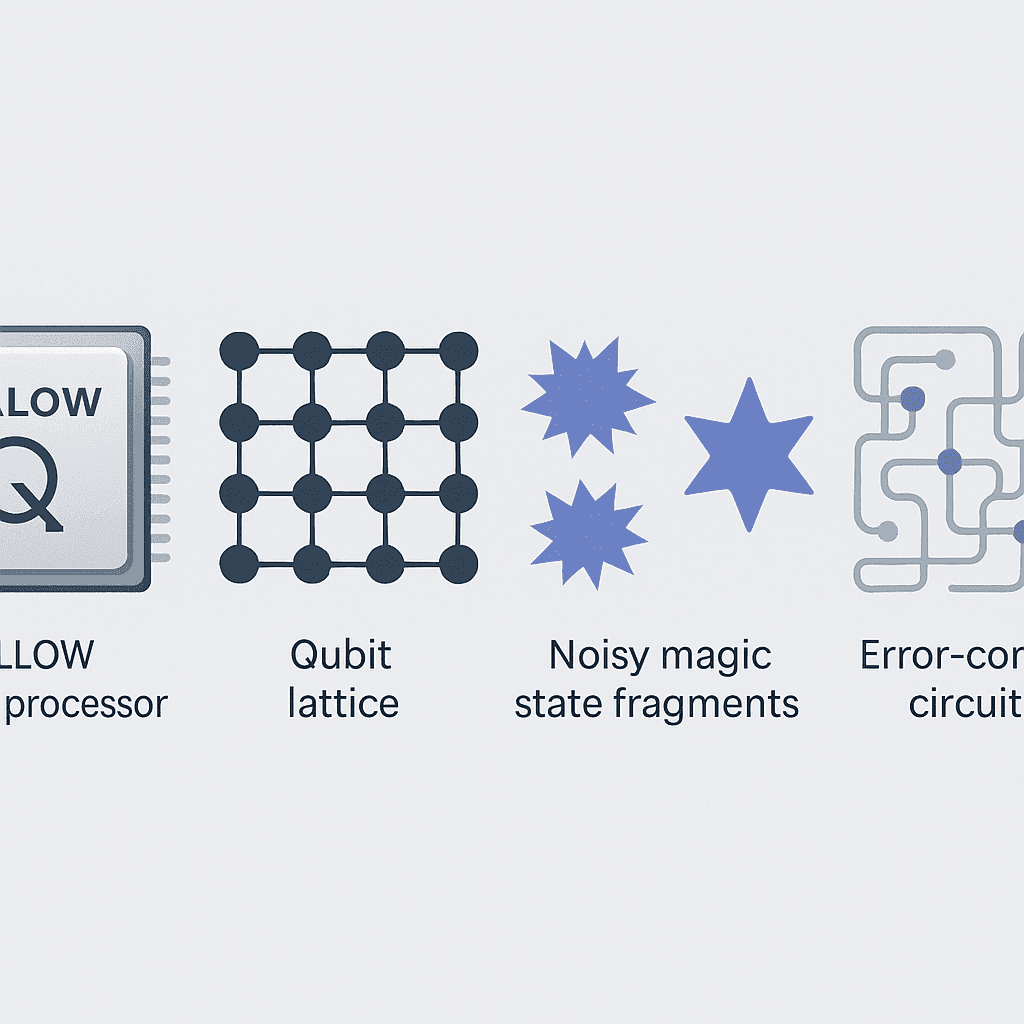
Google's cultivated magic states showed roughly 40 times fewer errors than states produced the conventional way, and the team separately reported a record 99.99 per cent logical fidelity for a specific type of magic state called a T-state. The process behind this result breaks into four distinct stages worth naming simply, injection, where a noisy state is introduced into a small region of the chip, filtration, where coordinated measurements actively detect and strip out errors, growth, where the surviving state is refined into a genuinely high purity form, and grafting, where that purified state is transferred onto a more robust part of the chip's error correcting structure for actual use.
The approach itself was developed theoretically back in 2024 by researchers Craig Gidney, Noah Shutty and Cody Jones. What makes this result genuinely significant is not the theory, it is that Google has now demonstrated the theory actually works on real, physical quantum hardware, not just on paper.
Why cutting the overhead actually matters more than making a faster chip
It would be easy to assume any quantum computing headline is about raw speed or qubit count, and this one genuinely is not. By dramatically reducing the resources needed to produce usable magic states, this approach could meaningfully shrink the physical size and total qubit count required to build a genuinely useful, error corrected quantum computer.
That distinction matters because qubit count and physical scale have been among the biggest practical barriers standing between today's experimental quantum processors and a machine capable of doing commercially useful work. A result that reduces how much of a quantum computer's capacity gets wasted on overhead, rather than one that simply adds more raw qubits, attacks the actual bottleneck more directly than most quantum computing headlines manage to.
The unglamorous part of the story that makes it credible
Google's own account of this result is not purely triumphant, and that is worth noting as a mark of credibility rather than a weakness. The research team reported that environmental noise, small room temperature fluctuations, drift from nearby electrical equipment, initially distorted their own benchmark measurements. They had to add hardware controls specifically to suppress that drift, and ultimately developed a self referential benchmark that uses the cultivation process itself to verify its own accuracy, a genuinely careful, methodical way to validate a result rather than simply claiming one.
Google CEO Sundar Pichai's own comment on the result was appropriately measured rather than overstated, calling it "another step towards useful, error-corrected quantum computers," language that frames this correctly as meaningful progress rather than a finished breakthrough.
What this means for any business, even though a useful quantum computer is still clearly years away
This is a genuine example of why "quantum computing is coming" deserves more nuance than a single headline can carry. Results like this one are specific, incremental, technically real steps, not evidence that a commercially useful quantum computer is imminent, nor evidence that quantum computing progress has stalled. Both oversimplified readings miss what actually happened here.
The resource efficiency angle is the detail worth remembering, not the raw technology itself. For any business trying to judge how seriously to take quantum computing timelines, progress on reducing the overhead needed to do useful quantum work is arguably a more meaningful signal than progress on raw qubit counts alone, because overhead reduction is what actually turns an experimental device into a practical one eventually.
Large scale manufacturing and system scaling genuinely remain ahead, and that is worth taking at face value rather than reading past it. Even Google's own reporting on this result is explicit that scaling this approach into a full, practical system is still a separate, substantial challenge, not a foregone conclusion simply because the underlying physics now works in a lab demonstration.
The honest read
This is a genuinely significant, carefully validated technical result, not hype dressed up as a breakthrough, and the specific problem it addresses, the overwhelming resource cost of producing usable magic states, has been a real structural bottleneck in quantum computing for two decades. It is also, honestly, still a lab result on a path that includes substantial manufacturing and scaling challenges ahead. The correct way to hold both of those facts at once is exactly how Google's own CEO described it, another real step, not the destination.
Sources
TECHMOOSE AI
Ready to put AI to work in your business?
TechMoose AI builds voice agents and chatbots that answer calls, take bookings and handle support, live in minutes, not months.
Try TechMoose AI