Nine years late, and worth the wait for spectacle if nothing else
Tesla's second generation Roadster was first unveiled back in 2017, with deliveries originally promised for 2020. It has slipped every year since, 2021, 2023, 2024, then a target of April 2026, then October 1, 2026, until bad weather forced Tesla to push the reveal a further two weeks. On 15 October, at SpaceX's rocket testing facility near Waco, Texas, it finally happened, livestreamed, in front of reservation holders and SpaceX staff.
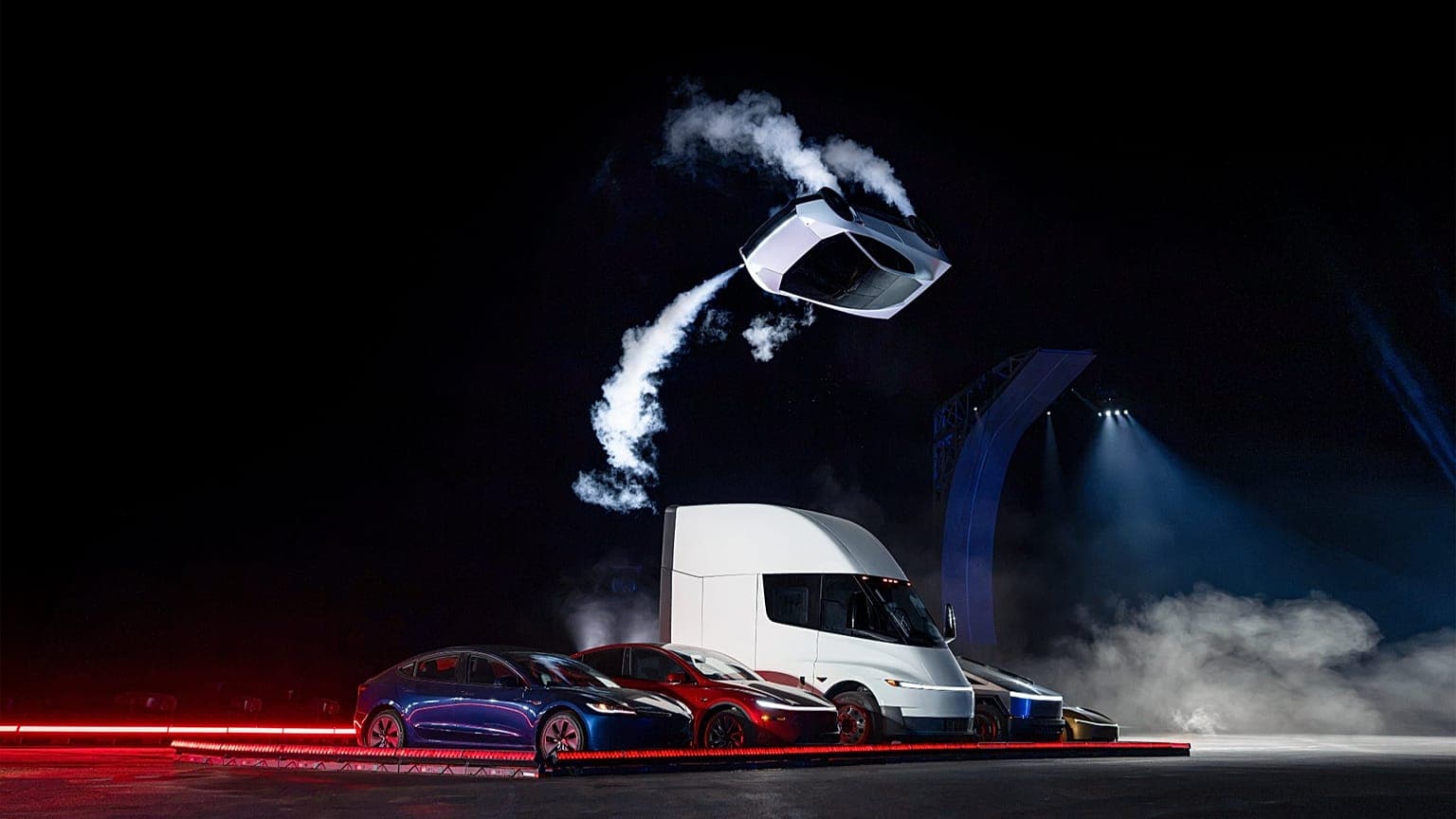
What Tesla showed was not a quiet unveiling of a sports car. The Roadster drove partway up a ramp that curled over into an inverted loop, held to the surface by what engineering vice president Lars Moravy described as a suction fan system, launched off the end of the ramp upside down, flipped itself upright mid air using compressed air thrusters, and landed on its wheels. In a second demonstration, it jumped over a line of parked Teslas, a Cybercab, Cybertruck, Tesla Semi, Model Y and Model 3, inverted itself mid jump, and again landed using its thrusters.
The engineering behind the stunt, in plain terms
Moravy said the car uses 10 thrusters connected to roughly 600 litres of compressed air to lift and spin the vehicle in midair, with a rechargeable air tank. Tesla said "every usable void" in the car's body is filled with carbon fibre overwrapped pressure vessels, the same type of high pressure tank linked to several SpaceX rocket explosions in the past, repurposed here to store compressed air rather than rocket propellant.
The car comes in three configurations, each with a different level of this technology built in. The base Performance trim, described as "road ready," uses the suction fan system only, with a sub 1.6 second 0 to 60 mph time and a $5,000 deposit. The Thrust trim adds rear mounted cold gas thrusters for a race focused version, with Tesla's own test recording a 0 to 60 mph time of 0.81 seconds, and a $250,000 deposit. The top tier Rocket trim, invite only with no price released, adds a full perimeter of cold gas thrusters for what Tesla describes as short flights, with a claimed sub 0.59 second 0 to 60 mph time. All three are claimed to exceed 300 miles of range, and Musk said the production version could eventually target around Mach 0.5, close to 383 mph.
Musk's own framing, which is more careful than the stunt suggests
Musk did not oversell this as a finished, polished product. Immediately after the landing, his comment was simply, "Well, it worked." Earlier he had set expectations by saying the demo's "success is not guaranteed," but that "it will probably work." He described the Roadster as "the best of the last of the human driven cars" and said he was "not sure it moves the needle massively from a revenue standpoint," an unusually blunt admission from a chief executive about his own low volume halo product.
He was also notably direct about safety, saying Tesla would "aspire not to kill anyone" in the car, that "safety is not the main goal," and that buyers who prioritise safety should not buy it. He floated the idea of eventually attempting to jump the Snake River Canyon, the site of Evel Knievel's famous failed steam rocket attempt in 1974, as a future stunt for the car.
Why "flying car" is doing a lot of work in that headline
It is worth being precise about what actually happened here, because the phrase "flying car" implies something closer to sustained, controllable flight than what was demonstrated. The Federal Aviation Administration told CBS News the vehicle does not meet its definition of an aircraft. A senior US Department of Transportation official voiced doubt about whether the vehicle will reliably do what Tesla showed, and acknowledged there is currently no clear answer on which regulator would actually oversee it, since the National Highway Traffic Safety Administration typically delegates vehicle safety certification to automakers themselves rather than independently verifying stunts like this one.
What was shown is better described as a short, thruster assisted aerial manoeuvre over a controlled, purpose built obstacle course, not a vehicle capable of flying from one place to another under its own power. That distinction matters for anyone trying to work out what this product actually is.
The skepticism, including from people who like Tesla
The most useful reactions here did not come from Tesla's usual critics, they came from people generally favourable to the company. YouTuber Marques Brownlee called the whole announcement a possible prank, pointing to the car's weight of over 4,000 pounds, the claimed top speed above 380 mph, and the 2028 production date as details that do not add up cleanly together. Tesla bull and analyst Gene Munster described the demonstration as "an engineering flex with no commercial value beyond embarrassing traditional automakers." Wedbush style analyst Dan Ives said plainly that the Roadster will not move meaningful volume or revenue for Tesla and that investors should not treat it as a growth driver, with production likely to stay limited. Motoring journalist Henry Catchpole, who attended in person for Hagerty, praised the demo itself but was candid that how it "translates into a finished, usable, enjoyable road car for enthusiasts remains to be seen."
What this means for any business watching Tesla, or watching hype cycles generally
A spectacular demo and a shipped product are two different milestones, and the gap between them here is specifically 2028. Tesla's own stated production date puts actual deliveries roughly two years out, after a reveal that was itself delayed by nine years from the original promise. Treat demo day enthusiasm and delivery date reality as two separate data points, not one.
When a company's own biggest supporters are the ones raising doubts, that scepticism carries more weight than the usual critics' version of the same complaint. Brownlee, Munster and Ives are not reflexively anti Tesla commentators, which makes their specific, numbers based doubts about weight, speed claims and production timing worth taking seriously rather than dismissing as predictable negativity.
Regulatory clarity, not engineering achievement, is usually the real bottleneck for genuinely novel vehicle categories. The FAA's statement that this does not meet its definition of an aircraft, and the unresolved question of which US regulator would actually oversee a thruster equipped road vehicle, is the detail likely to matter far more than the demo itself over the next two years.
The honest read
This was a genuinely impressive, carefully engineered piece of live theatre, and the core claim, that the car can launch itself off a ramp, right itself midair using thrusters, and land on its wheels, held up on the day in front of a live audience. It is also, by Musk's own admission, a low volume, low revenue impact product with a 2028 production date, built using high pressure air tanks of a type previously associated with SpaceX rocket failures, with no regulator currently willing to say who would oversee it on public roads. Calling it a "flying car" is a marketing choice more than a technical description. The honest takeaway is that Tesla demonstrated something genuinely novel and difficult, not that a flying car you can buy and drive to work is now a real, near term product.
Sources
- Tesla reveals SpaceX powered Roadster that flies and falls with style, TechCrunch, 15 Oct 2026
- With Tesla Roadster debut, Elon Musk shows "flying cars are real", CBS News, 15 Oct 2026
- "Something extraordinary": Tesla Roadster wows with compressed air thrusters for limited flight, Yahoo Finance, 15 Oct 2026
- Tesla unveils what it says is a flying car, called the Roadster, CNN, 15 Oct 2026
TECHMOOSE AI
Ready to put AI to work in your business?
TechMoose AI builds voice agents and chatbots that answer calls, take bookings and handle support, live in minutes, not months.
Try TechMoose AI