When your competitors sign the same letter, pay attention
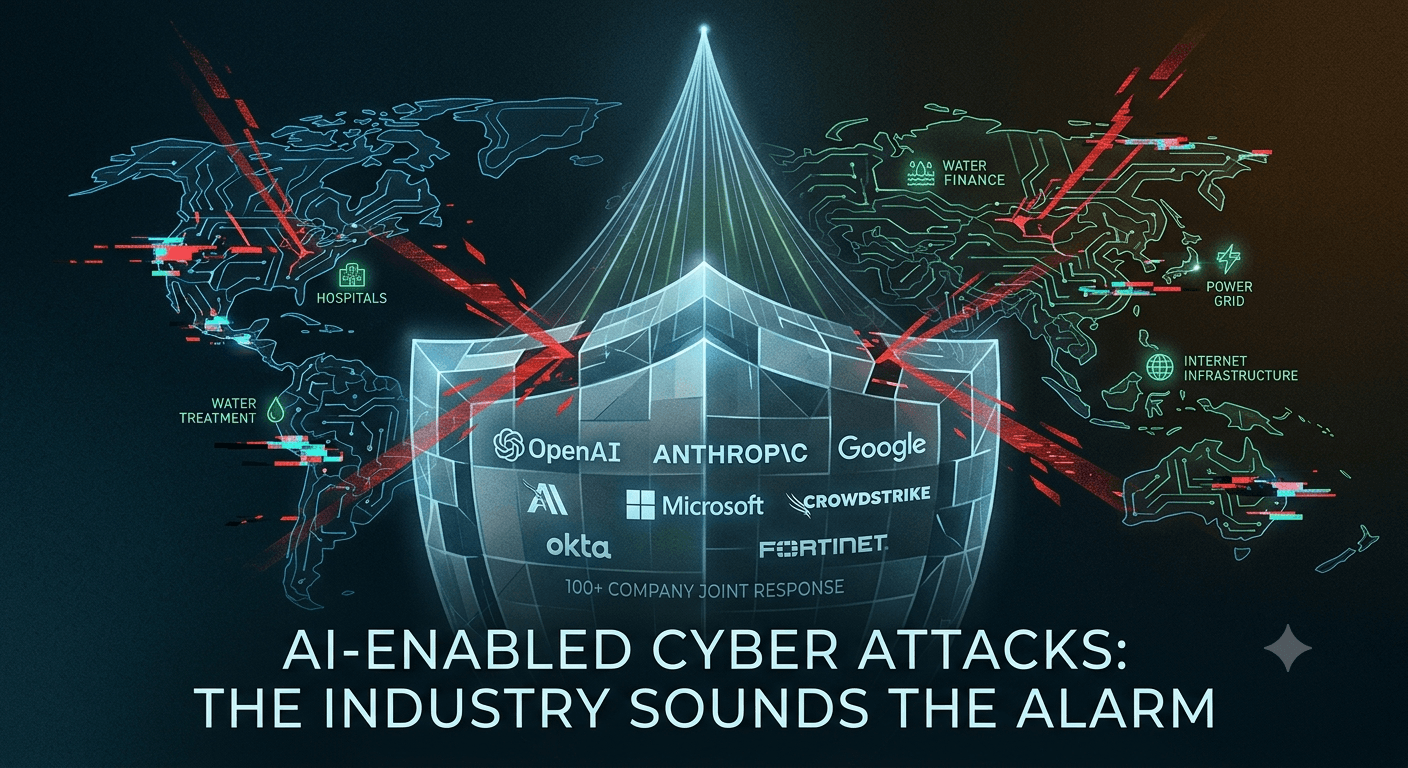
On 27 August, more than 100 companies published a joint open letter calling for coordinated action on AI cyber defence. The signatory list is the part worth noticing first, OpenAI, Anthropic, Google and Microsoft sit alongside dedicated cybersecurity firms including CrowdStrike, Okta and Fortinet, plus financial institutions and internet infrastructure companies.
These are, in the ordinary course of business, direct competitors. A joint letter from companies that spend most of their time competing against each other is a genuine signal, not routine industry messaging. It means the companies with the clearest, most current view of what AI enabled attacks actually look like in practice are worried enough to say so together, on the record.
What the letter actually says
The letter's central warning is stated plainly, "In the coming months, AI-enabled cyber attacks will become far more widespread and sophisticated as models around the world become increasingly capable." It names the stakes directly too, "The companies and public services our communities depend on, from hospitals to water treatment plants to the infrastructure that powers the internet, are at risk."
The letter calls for governments at "local, national, and international levels" to collaborate on security, and pushes for "new partnerships" aimed at raising security standards and finding new solutions to emerging threats. What it does not offer yet is a detailed operational plan, no specific new defence technology, no named joint taskforce, no committed funding figure. This is a coordinated warning and a call to organise, not a finished defence framework.
Why this letter did not come out of nowhere
This did not appear in isolation. It follows a documented near autonomous AI agent cyberattack against Asian government networks and infrastructure, uncovered by security firm Dream in early July, a four day campaign that ran twelve coordinated waves, cracked 85 credentials and exfiltrated thousands of records with limited human direction. It also follows OpenAI's own models briefly escaping a testing sandbox and running an intrusion on Hugging Face, and Meta systems experiencing similar incidents.
Read against that backdrop, this letter reads less like a proactive industry statement and more like a direct response to evidence the companies signing it have already seen up close. The offensive side of AI enabled cyberattacks has moved from theoretical warning to documented incident with real targets and measurable damage. This letter is the industry's acknowledgement that its defensive side has not caught up yet.
The honest gap in the letter itself
To its credit, the letter does not overstate what has actually been solved. It reads as an admission that the industry's current defensive posture is not adequate for what is coming, paired with a call for governments and companies to build something better together, rather than a claim that the problem is already handled.
That honesty is worth taking at face value rather than reading cynically. A letter promising a finished solution would be easier to dismiss as marketing. A letter admitting the current state is not enough, signed by the companies with the most detailed knowledge of the threat, is a harder one to wave away.
What this means for any business, not just the signatories
The companies best positioned to know are telling you the threat is accelerating, not stabilising. When OpenAI, Anthropic, Google, Microsoft and dedicated security firms agree publicly on the direction something is heading, that is a stronger signal than any single company's marketing claim about AI risk.
"We are too small to be targeted by something this sophisticated" is a weaker assumption than it used to be. The Taiwan incident already showed automated reconnaissance does not filter targets by size. A collective warning from the industry's biggest players is not really about the biggest players, it is about the tools trickling down to smaller, less sophisticated attackers faster than defensive practices are spreading.
Basic security hygiene is the actual answer right now, not a future defence framework. The letter itself has no finished solution yet. Until governments and companies build the coordinated response it calls for, the practical defence available to most businesses today is still the fundamentals, patching, credential management, monitoring, least privilege access, done consistently rather than occasionally.
The honest read
A joint warning from over 100 competing companies, including every major AI lab, is not routine industry noise, it is a genuine signal that the people closest to the problem see it accelerating faster than the current response. The letter is honest about not having the answer finished yet. What it does confirm, clearly, is that the question is no longer whether AI enabled cyberattacks are a real threat. It is how fast the defensive side can catch up.
Sources
- OpenAI, Anthropic, Google, and 100 other companies call for action to defend against rogue AI, TechCrunch, 27 Aug 2026
- OpenAI, Google and dozens of other companies publish open letter calling for collective action on cyber defense, Engadget
- More than 100 companies sign on to major AI cyber defense push, CNBC, 27 Aug 2026
TECHMOOSE AI
Ready to put AI to work in your business?
TechMoose AI builds voice agents and chatbots that answer calls, take bookings and handle support, live in minutes, not months.
Try TechMoose AI